What Is Resin Application on Marble? Why and How Is It Done?
Resin application on marble is a surface treatment process used to fill small cracks, pores, and cavities in natural stone in order to improve its durability, structural integrity, and visual quality. Particularly in marble varieties that naturally contain veins, microcracks, and pores, this process helps create a smoother, more stable, and aesthetically appealing surface.
Marble resin treatment can be applied during the processing of natural stone blocks or slabs. The resin penetrates the cavities on the stone surface, reinforcing weaker areas and helping achieve better results during subsequent production stages. For this reason, resin application is an important process in the natural stone industry, contributing to both product quality and processing performance.
What Is Resin Application on Marble?
Resin application on marble is the process of filling cracks, pores, and cavities on natural stone surfaces with specially formulated chemical resins. Epoxy-based and polyester-based resins are among the most commonly used materials for this purpose.
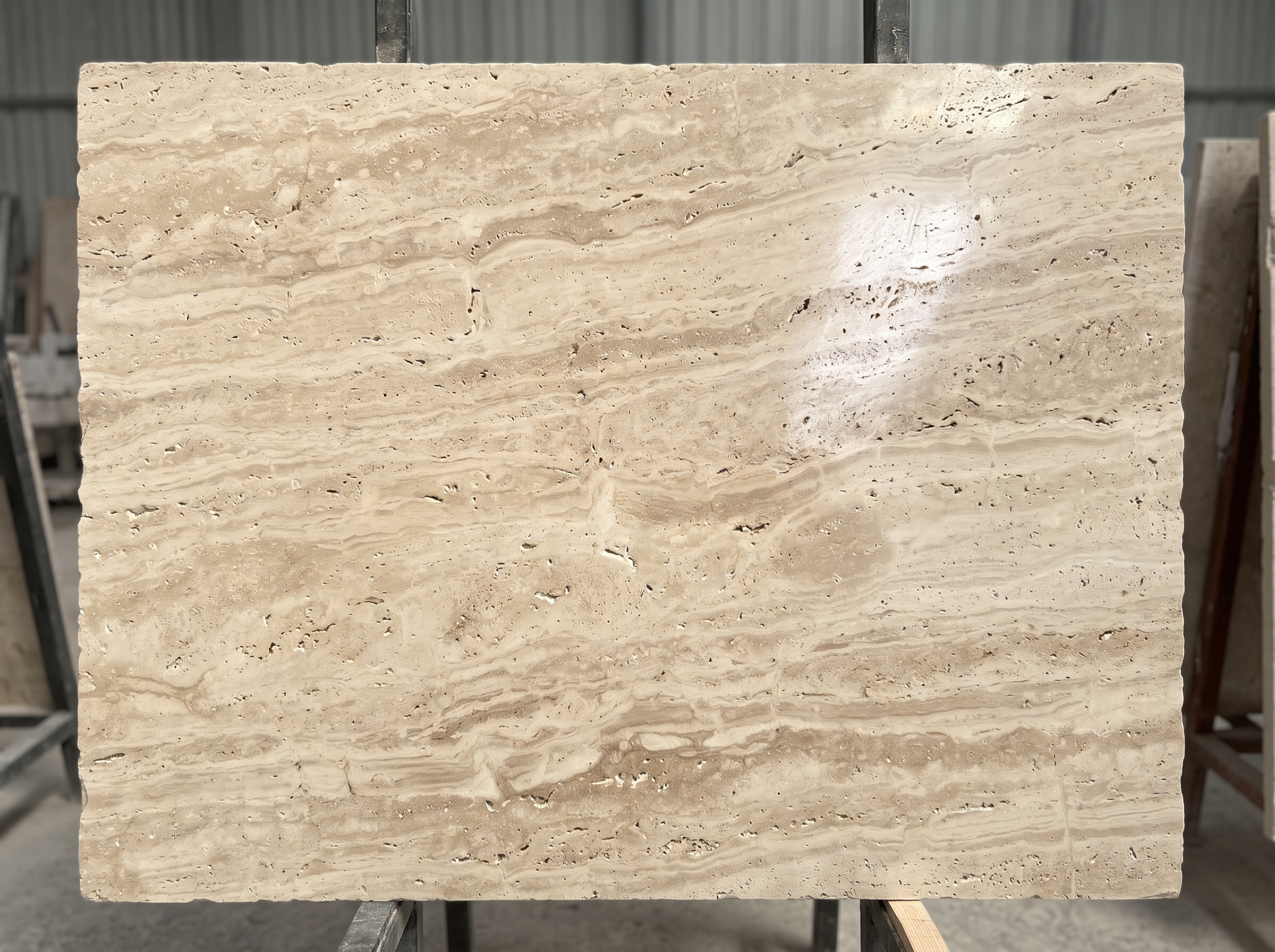
Natural marble may contain mineral variations, characteristic veins, and microcracks formed during its geological development. These natural features can influence the stone's physical properties. In marble varieties with prominent veining or natural cavities, resin application may be necessary to improve surface integrity.
During the process, resin is applied to the marble surface and penetrates its natural cavities. It then hardens under suitable conditions, filling these spaces and supporting the stone's structure. After treatment, the surface becomes more uniform, making subsequent operations such as polishing easier to control.
Resin application does not completely change the natural structure of marble. Its primary purpose is to reinforce existing weak areas, improve surface quality, and enhance workability.
Why Is Resin Applied to Marble?
The main purpose of marble resin treatment is to improve the performance of natural stone during production and use. The need for this process depends on the marble's mineral composition, vein structure, porosity, and existing cracks.
The main reasons for applying resin to marble include:
1. Filling Cracks and Cavities
Natural marble may contain small cracks and cavities formed during its geological development. Resin fills these areas and helps improve the overall integrity of the stone surface.
2. Improving Marble Durability
In marble varieties with numerous microcracks, resin application helps reinforce weaker areas. This can reduce the risk of damage during cutting, handling, transportation, and installation.
3. Enhancing Surface Quality
Resin treatment helps eliminate small surface cavities, resulting in a smoother and more uniform finish. This is particularly important in the production of polished marble slabs.
4. Preserving the Natural Appearance of Marble
The characteristic veins and color variations of marble are among the most important elements determining its aesthetic value. Resin application can improve the appearance of certain surface imperfections, helping create a more consistent overall look.
5. Reducing Production Losses
Reinforcing marble slabs with resin can help reduce the risk of breakage and surface deterioration during processing and transportation. This contributes to greater efficiency and improved product quality.
How Is Resin Applied to Marble?
Marble resin application consists of several stages, depending on the characteristics of the stone and the production method. In industrial facilities, specialized resin treatment lines and controlled curing systems are generally used.
The main stages of marble resin treatment are as follows:
1. Preparing the Marble Surface
In the first stage, the marble block or slab is cut into the required dimensions. The surface must be clean and free from dust, residues, and other contaminants before resin application.
Cracks, pores, and cavities are then inspected to determine the appropriate resin type and application method.
2. Drying the Marble
For resin to penetrate the stone properly and achieve effective adhesion, the moisture content of the marble must be controlled.
When necessary, marble slabs are dried in specialized industrial ovens. The drying temperature and duration depend on the technical specifications of the resin and the characteristics of the stone.
3. Preparing the Resin
The selected resin is prepared according to the manufacturer's technical instructions. For two-component resins, the main resin and hardener are mixed in the specified proportions.
Accurate mixing ratios are essential. Incorrect proportions may prevent the resin from curing properly or achieving the desired performance.
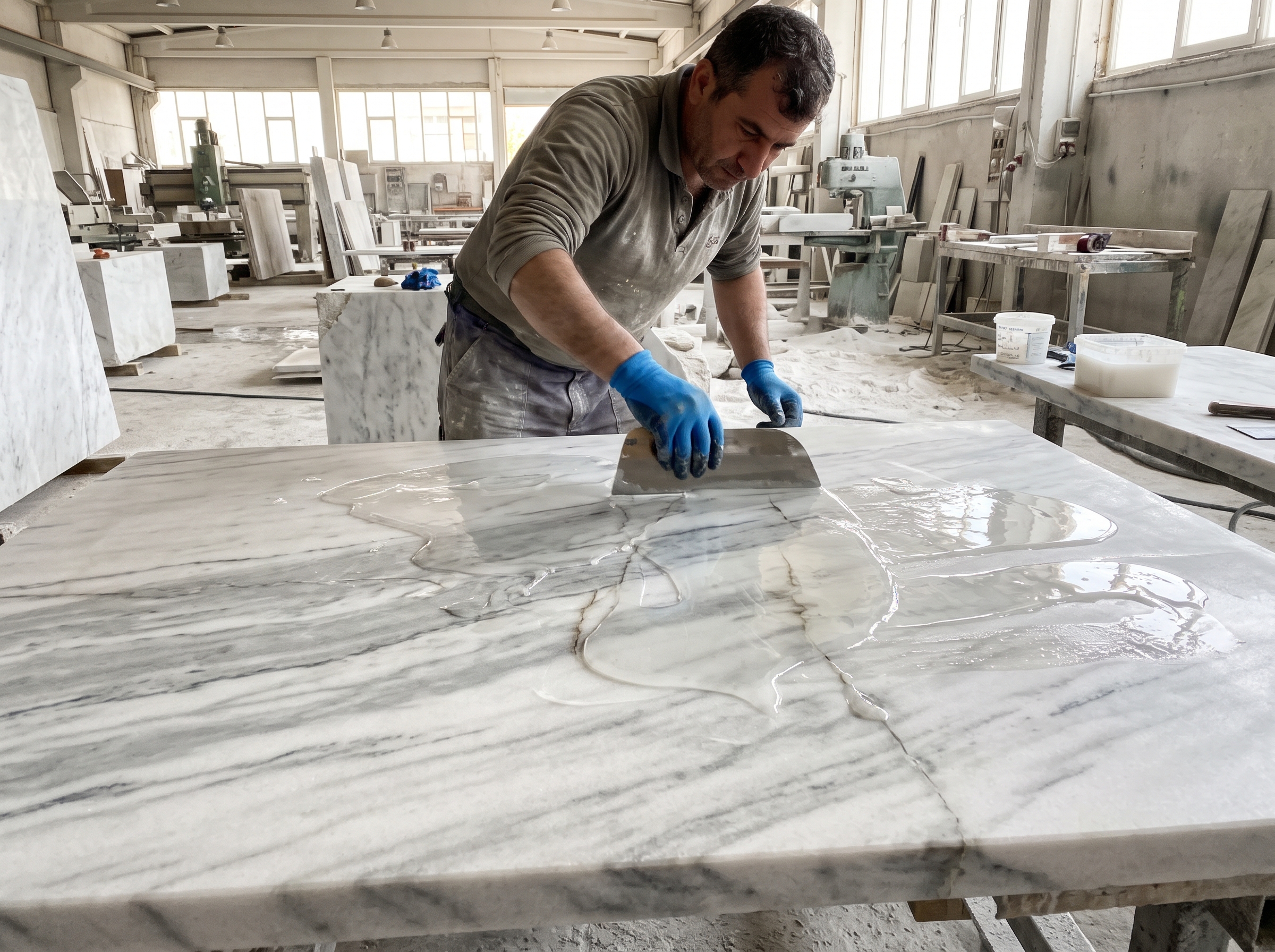
4. Applying Resin to the Marble Surface
The prepared resin is applied to the marble slab. During this stage, the material is distributed across the surface to penetrate cracks, microcavities, and pores.
Even distribution is important for achieving consistent results. In certain production systems, vacuum technology is used to help the resin penetrate deeper cavities.
5. Curing and Hardening
After application, the slab is left under suitable conditions or placed in a controlled heating system, depending on the resin manufacturer's technical specifications.
During this stage, the resin hardens, filling the cavities and bonding with the stone. Curing time varies according to the resin type, ambient temperature, and production system.
6. Removing Excess Resin and Polishing
Once curing is complete, excess resin remaining on the surface is removed. The marble slabs then undergo grinding and polishing according to the stone's characteristics and the desired surface finish.
As a result, a smoother, more consistent, and aesthetically refined marble surface is obtained.
Which Types of Resin Are Used for Marble Treatment?
The type of resin used in marble production depends on the stone's structure, the purpose of the treatment, and production conditions. Epoxy and polyester resins are among the most widely used options.
| Resin Type | Characteristics | Main Applications |
|---|---|---|
| Epoxy resin | Offers strong adhesion and good mechanical properties. | Filling cracks and reinforcing natural stone |
| Polyester resin | Can provide fast curing and easy processing. | General surface improvement and cavity filling |
| UV-curable resin | Hardens under ultraviolet light in suitable systems. | Specialized surface and production applications |
Not every resin is suitable for every marble variety. The correct product should be selected by considering the stone's porosity, crack structure, color, and processing requirements.
For light-colored marble varieties, particular attention should be paid to resin color compatibility and resistance to yellowing over time.
Resin-Treated Marble vs. Untreated Marble: What Are the Differences?
The main difference between resin-treated and untreated marble is whether the natural cavities and cracks on the stone surface have been filled and reinforced with resin.
| Comparison | Resin-Treated Marble | Untreated Marble |
|---|---|---|
| Surface structure | Cavities and microcracks may be filled. | Natural surface characteristics remain visible. |
| Appearance | Can provide a more uniform surface. | Natural cavities and cracks may remain visible. |
| Workability | Proper treatment can improve stability during processing. | Depends on the stone's natural structure. |
| Durability | Weaker areas can be reinforced. | Retains its original physical characteristics. |
| Maintenance | Depends on usage conditions and surface treatment. | May require protection depending on porosity. |
It is important to note that resin-treated marble is not necessarily more durable than untreated marble in every case. The type of resin, application quality, and natural characteristics of the stone all influence the final result.
Which Types of Marble Require Resin Application?
Resin application is a surface improvement method used for different types of natural stone. However, not every marble variety requires resin treatment.
The process may be preferred for marble with the following characteristics:
-
Marble with dense or prominent veining
-
Marble containing natural microcracks
-
Natural stones with porous surface structures
-
Slabs requiring additional support during cutting and handling
-
Stones with surface cavities that need to be filled before polishing
The need for resin treatment cannot be determined solely by the color or pattern of the marble. Its physical properties and behavior during processing must also be evaluated.
What Are the Advantages of Resin Application on Marble?
When the correct resin and application method are used, marble resin treatment offers several advantages.
Improves surface integrity: Helps fill small cracks and cavities.
Supports processing performance: Can make marble slabs easier to handle during cutting, grinding, and polishing.
Enhances visual quality: Creates a more uniform appearance by improving certain surface imperfections.
Can reduce production losses: Reinforcing weaker areas helps lower the risk of damage during production and transportation.
Supports overall product quality: Contributes to better-quality slabs, particularly in marble varieties with prominent veining.
However, resin application cannot eliminate every natural imperfection or completely remove the need for proper marble maintenance.
Does Resin-Treated Marble Turn Yellow?
One of the most frequently asked questions about marble resin application concerns the possibility of yellowing.
Yes, certain resins may undergo color changes over time. Depending on their chemical composition, exposure to sunlight and ultraviolet radiation can cause some resins to turn yellow.
For this reason, the following properties should be considered when selecting a resin:
-
UV resistance
-
Color stability
-
Resistance to yellowing
-
Compatibility with the natural color of the marble
-
Suitability for the intended application area
For marble intended for outdoor use, selecting products with suitable UV resistance and application specifications is particularly important.
Where Is Resin-Treated Marble Used?
Resin-treated marble can be used in various architectural and decorative applications, depending on the stone's technical properties and surface quality.
Common applications include:
-
Kitchen countertops
-
Bathroom countertops and vanity areas
-
Flooring
-
Interior wall cladding
-
Hotel and restaurant projects
-
Staircases and steps
-
Decorative marble panels
-
Custom-sized natural stone applications
When selecting marble for a particular application, water absorption, abrasion resistance, chemical resistance, and surface finish should all be considered. Resin treatment alone does not automatically make marble suitable for every outdoor or heavy-duty application.
Does Resin Application Affect the Natural Character of Marble?
Resin application does not alter the natural mineral composition of marble. Its purpose is to fill surface cavities and cracks while reinforcing the existing structure of the stone.
However, the color, transparency, and amount of resin used may influence the marble's visual appearance. Choosing the correct resin is especially important for light-colored marble varieties and stones with distinctive veining.
When applied correctly, resin can improve surface quality while preserving the natural patterns and characteristic veins of the marble.
Frequently Asked Questions About Marble Resin Application
Is resin application mandatory for marble?
No. Not every marble variety requires resin treatment. The need for application depends on the stone's porosity, crack density, and physical characteristics during processing.
Does resin-treated marble absorb water?
Resin can help reduce water absorption by filling the pores and cavities in the treated areas. However, it does not make the entire marble slab completely waterproof. Other surfaces, edges, and the stone's natural structure may still allow moisture absorption.
How long does marble resin take to cure?
Curing time depends on the chemical composition of the resin, ambient temperature, application thickness, and curing method. Therefore, there is no single curing time that applies to every resin product.
Can resin-treated marble be polished?
Yes. Once the resin has fully cured, the marble can be ground and polished using suitable abrasives. This helps achieve a smooth and glossy surface.
Does resin application increase the value of marble?
High-quality resin treatment can improve the visual appearance and workability of marble. This may contribute positively to its commercial value. However, the stone's natural quality, color, veining, and other physical properties also play an important role in determining its price.
Conclusion
Resin application on marble is an important natural stone treatment used to improve surface quality, fill microcracks and cavities, and support the stone's durability during processing.
Selecting the appropriate resin, preparing the surface correctly, and controlling the curing process are essential factors that determine the success of the application.
By preserving the aesthetic characteristics of natural marble while improving the quality and workability of the slabs, resin treatment remains an important part of modern natural stone production.