What Are the Different Types of Marble Edge Finishes? Bevel, Polishing and Edge Profiles
Marble edge finishing is an important part of natural stone fabrication. It influences not only the appearance of a marble product but also its usability, safety and overall finish quality. Depending on the application and design requirements, marble edges can be shaped, smoothed, rounded or decorated using different techniques.
Beveling, edge polishing and decorative profiling are among the most common marble edge-finishing processes. A bevel creates an angled edge to soften sharp corners, while edge polishing produces a smooth and refined finish. Decorative profiles give marble edges distinctive shapes that complement different architectural styles.
What are the most common types of marble edge finishes? What is the difference between a bevel and a polished edge? Which edge profiles are suitable for marble countertops, stair treads, tables and other natural stone applications?
This guide explores the main marble edge-finishing techniques, their characteristics, production stages and typical applications.
What Is Marble Edge Finishing?
Marble edge finishing refers to the process of shaping, smoothing or polishing the exposed edges of cut marble pieces. The selected finish depends on the intended use, the desired appearance and the technical requirements of the project.
In natural stone production, marble blocks are first processed into slabs. These slabs are then cut into specific dimensions according to project requirements. The exposed edges are subsequently finished to achieve the requested shape and surface quality.
The main purposes of marble edge finishing include:
-
Removing sharp edges created during cutting
-
Smoothing irregularities and rough areas
-
Improving the overall appearance of the finished product
-
Creating edge shapes suitable for specific applications
-
Refining installation and joining details
-
Achieving a modern, classic or decorative design
The appropriate edge finish should always be selected according to the intended application. For example, everyday usability is an important consideration for kitchen countertops, while edge durability and visual consistency are particularly relevant for stair treads.
What Are the Different Types of Marble Edge Finishes?
Marble edges can be finished in various shapes and surface textures. Common options include straight edges, bevelled edges, polished edges, half bullnose, full bullnose and decorative profiles.
1. Straight Edge
A straight edge is a simple, linear finish in which the marble edge retains a straight, clean shape. It is widely used in contemporary architecture and minimalist interior design.
The cut edge is ground and finished to create a smooth, even surface. Depending on the design, a small bevel or eased corner can also be added to soften the sharpness.
Common applications:
-
Kitchen and bathroom countertops
-
Marble dining tables and coffee tables
-
Wall cladding
-
Minimalist interior design projects
-
Large-format natural stone panels
Straight edges are particularly suitable for projects where clean lines and understated details are preferred.
2. Bevelled Edge
A bevelled edge is created by cutting the sharp corner of a marble piece at an angle, forming a sloping surface. This process softens the appearance of the edge and helps reduce the risk associated with sharp corners.
Bevels can be produced in different widths and angles. Small bevels are commonly used to remove sharp corners, while wider bevels can create a more noticeable decorative detail.
Common applications:
-
Kitchen countertops
-
Bathroom vanity tops
-
Marble tables and coffee tables
-
Stair treads
-
Wall and floor finishing details
The bevel width and angle should be determined according to the marble thickness and the design requirements of the project.
3. Edge Grinding and Polishing
Edge grinding and polishing, commonly referred to as edge polishing or rodaj in Turkish stone fabrication terminology, is the process of smoothing and refining the exposed edge of a marble piece.
Unlike a specific decorative profile, this process primarily focuses on improving the condition and surface quality of the edge. Depending on the requested finish, the edge can be left matte, honed or polished.
This process is particularly important in the production of marble countertops and tabletops, where exposed edges need to have a consistent and refined appearance.
Common applications:
-
Kitchen and bathroom countertops
-
Marble tabletops
-
Window sills
-
Stair treads and thresholds
-
Custom-sized marble components
The quality of edge polishing depends on several factors, including the abrasive sequence, machine settings, stone characteristics and precision of the fabrication process.
4. Half Bullnose Edge
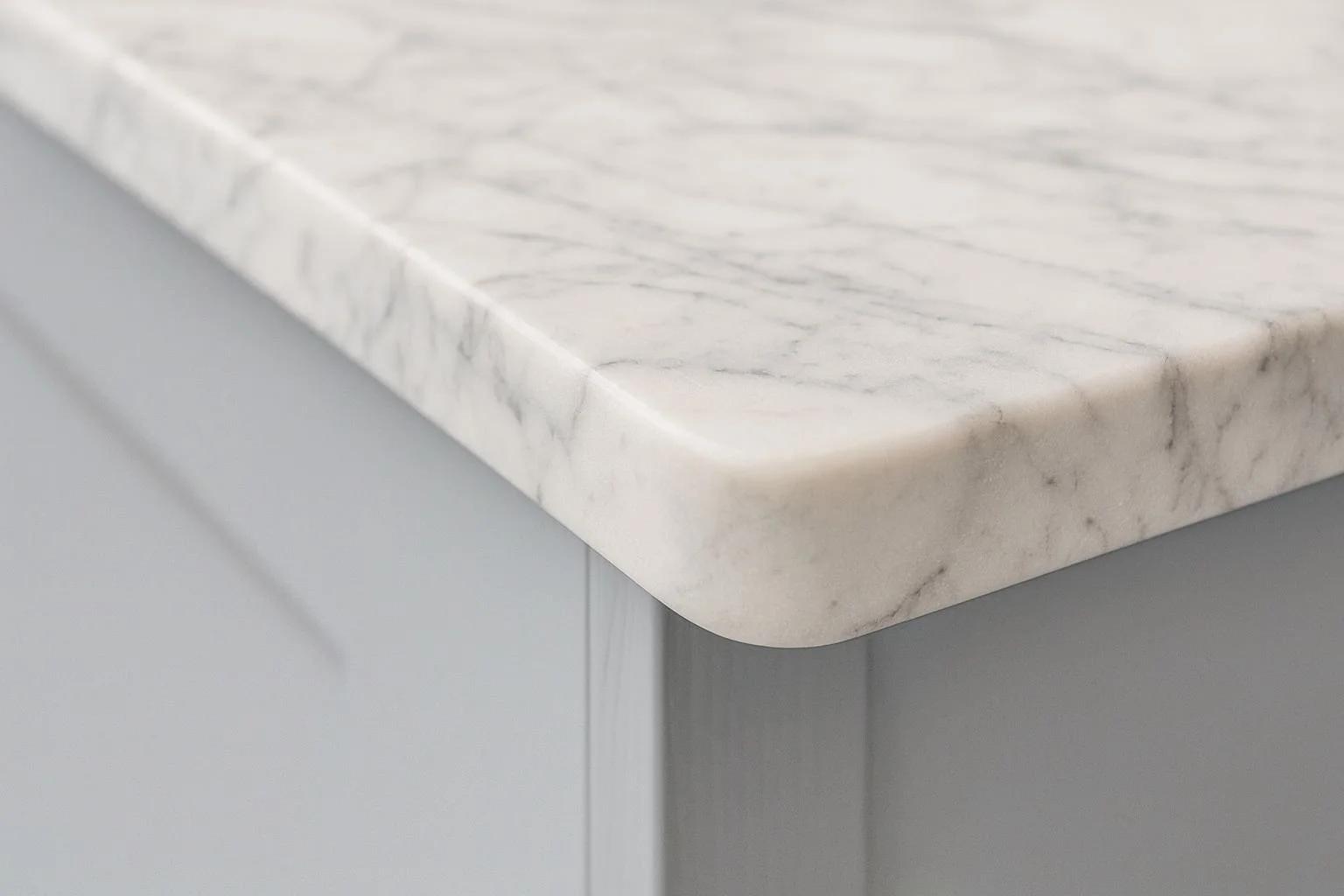
A half bullnose edge features a rounded upper corner while the lower part of the edge generally remains straight. This creates a softer transition and a gently curved appearance.
This profile is often selected for traditional and transitional interior designs. Its curved shape also helps reduce the sharpness of exposed corners.
Common applications:
-
Kitchen countertops
-
Bathroom vanity tops
-
Stair treads
-
Window sills
-
Marble tables and coffee tables
5. Full Bullnose Edge
A full bullnose edge has a more extensively rounded cross-section, with both the upper and lower transitions forming a curved shape.
This profile creates a soft, rounded appearance and is often used in classic interiors and decorative natural stone applications.
Common applications:
-
Kitchen and bathroom countertops
-
Stair treads
-
Table and coffee table edges
-
Decorative marble elements
The suitability of a full bullnose profile depends on the thickness of the marble and the required edge geometry.
6. Decorative Marble Edge Profiles
Decorative edge profiles give marble edges distinctive shapes beyond standard straight or rounded finishes. They are frequently used in classical architecture, luxury interiors and custom-designed projects.
Common decorative profiles include:
-
Ogee edge: An elegant S-shaped profile that creates a traditional and decorative appearance.
-
Dupont edge: A distinctive profile featuring a more pronounced upper projection and a curved lower transition.
-
Cove edge: An inward-curving, concave profile.
-
Bullnose variations: Rounded profiles produced with different radii and transitions.
-
Custom profiles: Special edge geometries designed according to architectural drawings or customer specifications.
When selecting a decorative profile, marble thickness, veining, intended application and fabrication requirements should all be considered.
What Is the Difference Between Beveling, Edge Polishing and Profiling?
Although these processes are related, beveling, edge polishing and profiling do not refer to the same operation. Each serves a different purpose in marble fabrication.
|
Process |
Main purpose |
Effect on the edge |
|---|---|---|
|
Beveling |
Removing sharp corners |
Creates an angled surface |
|
Edge polishing |
Smoothing and refining the edge |
Produces a smooth, matte or glossy finish |
|
Profiling |
Creating a decorative shape |
Forms a specific geometric or curved profile |
|
Half bullnose |
Creating a rounded edge |
Rounds the upper section |
|
Full bullnose |
Fully rounding the edge |
Creates a more extensively curved cross-section |
An important point is that these processes can be combined. For example, a marble edge can first be shaped into a decorative profile and then ground and polished to achieve the required surface finish. Therefore, beveling, polishing and profiling are not necessarily alternatives; they can be complementary stages of the same fabrication process.
How Is Marble Edge Finishing Carried Out?
Marble edge finishing is a controlled fabrication process. The exact method depends on the machinery, stone characteristics and requested edge geometry.
The general production stages are as follows:
1. Cutting and Dimensioning
The marble slab is cut according to the required dimensions. Before edge finishing begins, the dimensions, thickness and cutting accuracy of the piece are checked.
2. Edge Preparation
Any roughness or minor irregularities created during cutting are removed. The edge is prepared for subsequent grinding and shaping operations.
3. Profile Formation
The requested bevel, half bullnose, full bullnose or decorative profile is created. Suitable diamond tools and edge-processing machines may be used depending on the required geometry.
4. Grinding and Polishing
The shaped edge is gradually ground using abrasive tools. The final surface can be matte, honed or polished, depending on the design specification.
5. Final Quality Inspection
The finished product is checked for edge shape, dimensions, surface quality and overall appearance. Consistency is particularly important for exposed edges that remain visible after installation.
Which Marble Edge Finish Should You Choose for Different Applications?
The right edge finish depends on the functional and aesthetic requirements of the application. Not every profile is suitable for every project.
|
Application |
Possible edge finishes |
Main consideration |
|---|---|---|
|
Kitchen countertops |
Straight, bevelled, half bullnose |
Everyday use and maintenance |
|
Bathroom vanity tops |
Straight, bevelled, rounded |
Design and edge finish |
|
Stair treads |
Bevelled, polished, rounded |
Edge durability and safety |
|
Tables and coffee tables |
Straight, half bullnose, decorative |
Visual appearance |
|
Window sills |
Straight, bevelled, rounded |
Clean and consistent finishing |
|
Wall cladding |
Straight, bevelled |
Joint and finishing details |
|
Classical architectural projects |
Ogee and custom profiles |
Decorative design |
For stairs and flooring applications, the edge profile alone does not guarantee slip resistance or overall safety. The stone surface finish, installation details, stair design and relevant safety requirements should also be evaluated.
Factors to Consider When Choosing a Marble Edge Profile
Before selecting an edge finish, several technical and aesthetic factors should be evaluated:
-
Marble thickness: Some profiles require sufficient material thickness to achieve the desired shape.
-
Stone characteristics: Mineral composition, veining, natural fractures and structural properties can affect fabrication.
-
Application: Countertops, stair treads and decorative elements have different functional requirements.
-
Design style: Straight and bevelled edges generally suit contemporary designs, while ogee and other decorative profiles are often preferred for classical interiors.
-
Maintenance: Complex profiles may require more attention during cleaning than simple straight edges.
-
Fabrication capabilities: The selected profile should be compatible with the available machinery and production methods.
A well-selected edge profile should complement the natural appearance of marble while meeting the technical requirements of the project.
Frequently Asked Questions About Marble Edge Finishing
What is the most common marble edge finish?
Straight and bevelled edges are among the most commonly used options, particularly for countertops, window sills and other interior applications. Rounded and decorative profiles are also popular depending on the project.
What is the difference between a bevelled edge and a rounded edge?
A bevelled edge has an angled, flat surface that replaces a sharp corner. A rounded edge has a curved transition. Both can soften sharp corners, but they create different visual effects.
What does rodaj mean in marble processing?
Rodaj refers to grinding and refining the exposed marble edge to achieve a smooth and even finish. Depending on the requested result, the edge can be finished with a matte, honed or polished appearance.
Can marble edges be polished after profiling?
Yes. After a marble edge has been shaped into the desired profile, it can be ground and polished to achieve the required surface quality. The appropriate finishing method depends on the stone and the profile.
Which marble edge profile is best for kitchen countertops?
Straight, bevelled, half bullnose and full bullnose edges are all possible options. The best choice depends on the countertop design, marble thickness, intended use and personal preference.
Can custom marble edge profiles be produced?
Yes. Custom profiles can be developed according to architectural drawings, technical specifications and project requirements, provided that the requested geometry is compatible with the stone and fabrication equipment.
Conclusion
Marble edge finishing is an essential detail in natural stone fabrication. From simple straight edges and bevels to rounded and decorative profiles, each technique offers different aesthetic and functional characteristics.
Choosing the right edge treatment requires consideration of marble thickness, stone properties, intended application and overall design. When these factors are evaluated together, the finished marble product can achieve a more refined appearance and better suitability for its intended use.
At Biser Marble, natural stone products are supplied for a variety of architectural and interior design applications. Understanding the available finishing options helps architects, designers, contractors and buyers make more informed decisions when specifying marble for their projects.