Marble Kitchen Islands: Design Ideas and Material Selection
Kitchen islands have become an essential feature of modern kitchen design, combining functionality with visual appeal. They can serve as food preparation areas, breakfast counters, additional storage units or social spaces where family and guests gather. With the right material selection, a kitchen island can become the focal point of the entire kitchen.
Among natural stone options, marble is widely appreciated for its distinctive veining, natural colour variations and timeless appearance. Using marble on a kitchen island can introduce elegance and natural character into the space while complementing a variety of interior design styles.
However, selecting marble for a kitchen island requires more than choosing an attractive colour or pattern. Physical properties, surface finishes, maintenance requirements, slab dimensions and fabrication details should also be considered.
What should you consider when choosing marble for a kitchen island? Which marble colours and veining patterns work best with different kitchen styles? What are the advantages and limitations of marble kitchen islands?
In this guide, we explore marble kitchen island designs, material selection criteria, surface finishes and practical maintenance recommendations.
Why Choose Marble for a Kitchen Island?
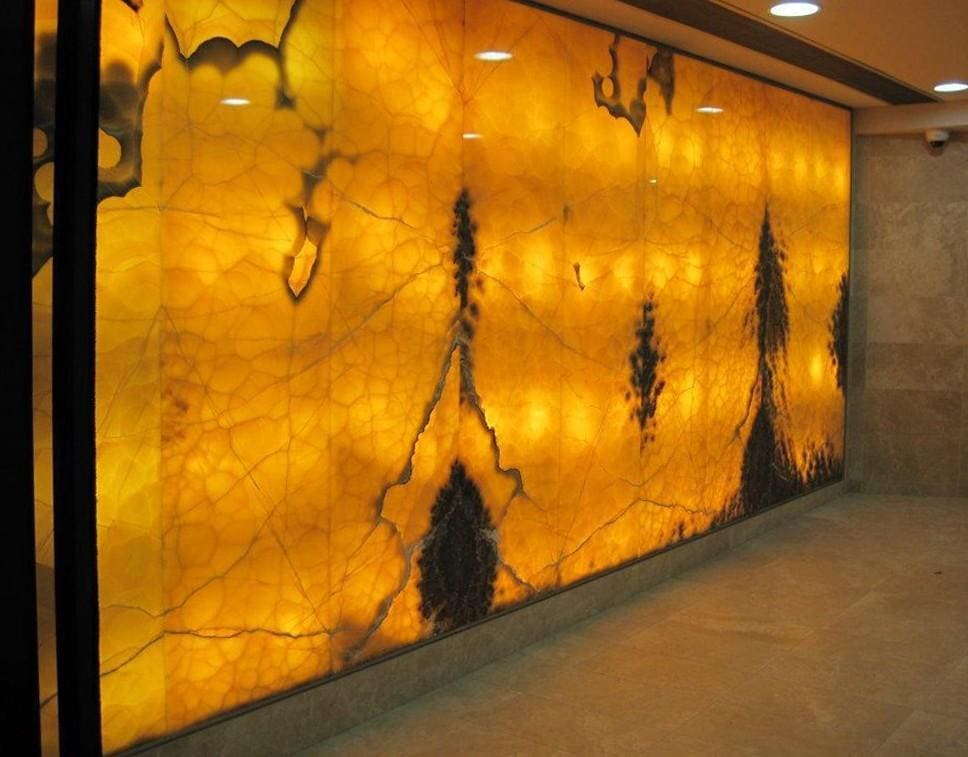
Marble is a natural stone formed through geological processes over millions of years. Its distinctive mineral composition, veining and colour variations give each slab a unique appearance. This natural diversity makes marble an attractive option for kitchen islands, where large stone surfaces can create a strong visual impact.
The main reasons for choosing marble for kitchen islands include:
-
Unique natural patterns: Every marble slab has its own veining and colour distribution.
-
Timeless appearance: Marble can complement both contemporary and traditional kitchen designs.
-
Colour variety: Marble is available in white, grey, darker shades and various other natural colour combinations.
-
Different surface finishes: Polished, honed and textured finishes offer different aesthetic possibilities.
-
Design flexibility: Marble can be used for countertops, island side panels, backsplashes and decorative details.
The natural patterns of marble can become a prominent design feature, particularly on large and visible kitchen island surfaces.
What Should You Consider When Choosing Marble for a Kitchen Island?
Selecting marble for a kitchen island should involve more than evaluating its colour and veining. The stone's physical properties, surface finish, slab thickness and intended application should all be assessed.
1. Marble Colour and Veining
Colour and veining are among the first characteristics considered when selecting marble. They influence the overall atmosphere of the kitchen and determine how prominently the island stands out.
Light-coloured marble can create a bright and spacious appearance. Grey tones are often suitable for contemporary and balanced interiors, while darker marble can introduce contrast and a more dramatic visual effect.
Veining is equally important. Bold, contrasting veins can turn a kitchen island into the centrepiece of the room. More subtle and delicate patterns may be better suited to minimalist designs.
2. Physical Properties of Marble
Marble can have a certain level of porosity due to its natural structure. Depending on its mineral composition, it may also react with acidic substances, resulting in surface dulling or etching.
Since kitchen islands are exposed to food, beverages, oils and cleaning products during everyday use, the physical properties of the selected stone should be carefully evaluated.
The following characteristics are worth considering:
-
Water absorption
-
Porosity
-
Hardness and abrasion resistance
-
Sensitivity to acidic substances
-
Natural fissures and veining
-
Maintenance requirements of the selected surface finish
These characteristics vary depending on the marble variety and its mineralogical composition. Whenever possible, the technical information of the selected slab should be reviewed before making a final decision.
3. Surface Finish: Polished or Honed Marble?
The surface finish of marble affects both the appearance of the kitchen island and the everyday experience of using it.
Polished Marble
Polished marble has a glossy, reflective surface that can enhance the visibility of natural veining and colour variations.
It is frequently selected for elegant, bright and traditional kitchen designs. However, scratches, stains and surface changes may become more noticeable under certain lighting conditions.
Honed Marble
Honed marble has a matte or low-sheen appearance, offering a more understated and natural aesthetic.
It can complement modern, minimalist and warm-toned kitchen interiors. Its maintenance requirements depend on the stone's characteristics and any protective treatments applied.
|
Feature |
Polished Marble |
Honed Marble |
|---|---|---|
|
Appearance |
Glossy and reflective |
Matte or low-sheen |
|
Veining |
Often more visually pronounced |
May appear softer |
|
Design style |
Elegant and classic |
Minimalist and contemporary |
|
Surface feel |
Smooth and glossy |
Natural and matte |
|
Maintenance |
Requires stone-appropriate care |
Requires stone-appropriate care |
Regardless of the selected finish, marble's sensitivity to acidic substances should be considered and appropriate maintenance practices should be followed.
4. Slab Thickness and Edge Details
Slab thickness and edge profiles are important design considerations for marble kitchen islands.
Thicker-looking countertops can create a substantial and distinctive appearance, while thinner edge details are often preferred in minimalist kitchens. Special fabrication and joining techniques can also be used to achieve the appearance of a thicker countertop.
Common edge finishing options include:
-
Straight edge
-
Bevelled edge
-
Half bullnose edge
-
Full bullnose edge
-
Custom decorative edge profiles
The selected edge treatment should be compatible with the marble thickness, overall design and intended use.
Popular Marble Colours for Kitchen Islands
The natural colour and veining variations of marble allow it to complement a wide range of kitchen styles. When selecting a colour, cabinetry, flooring, wall finishes, lighting and other materials should be considered together.
White and Light-Coloured Marble
White and light-coloured marble is often chosen to create a bright and spacious appearance. When combined with grey or darker veins, the natural patterns of the stone become an important design feature.
White marble can complement light-coloured cabinets, wooden details and metallic accessories.
Grey Marble
Grey marble is a popular option for contemporary and industrial-inspired kitchen interiors. Light grey tones create a subtle appearance, while darker grey and charcoal shades can introduce stronger contrasts.
Grey marble can be combined with white, black, wood and metal finishes.
Dark-Coloured Marble
Dark marble can be an attractive choice for homeowners who want their kitchen island to become a prominent design feature. Black, dark grey and similar shades can create striking contrasts with lighter cabinetry.
Veining, surface finish and lighting should be considered together when selecting darker marble.
Beige and Earth-Toned Marble
Beige and earth-toned marble can introduce warmth and a natural atmosphere into the kitchen. These colours work particularly well with wooden cabinetry, neutral colour palettes and soft lighting.
When selecting marble, it is important to consider not only the overall colour but also the direction, density and distribution of the veins across the slab.
Marble Kitchen Island Design Ideas
Marble can be incorporated into kitchen islands in several ways. The most suitable design depends on the size of the kitchen and the overall interior concept.
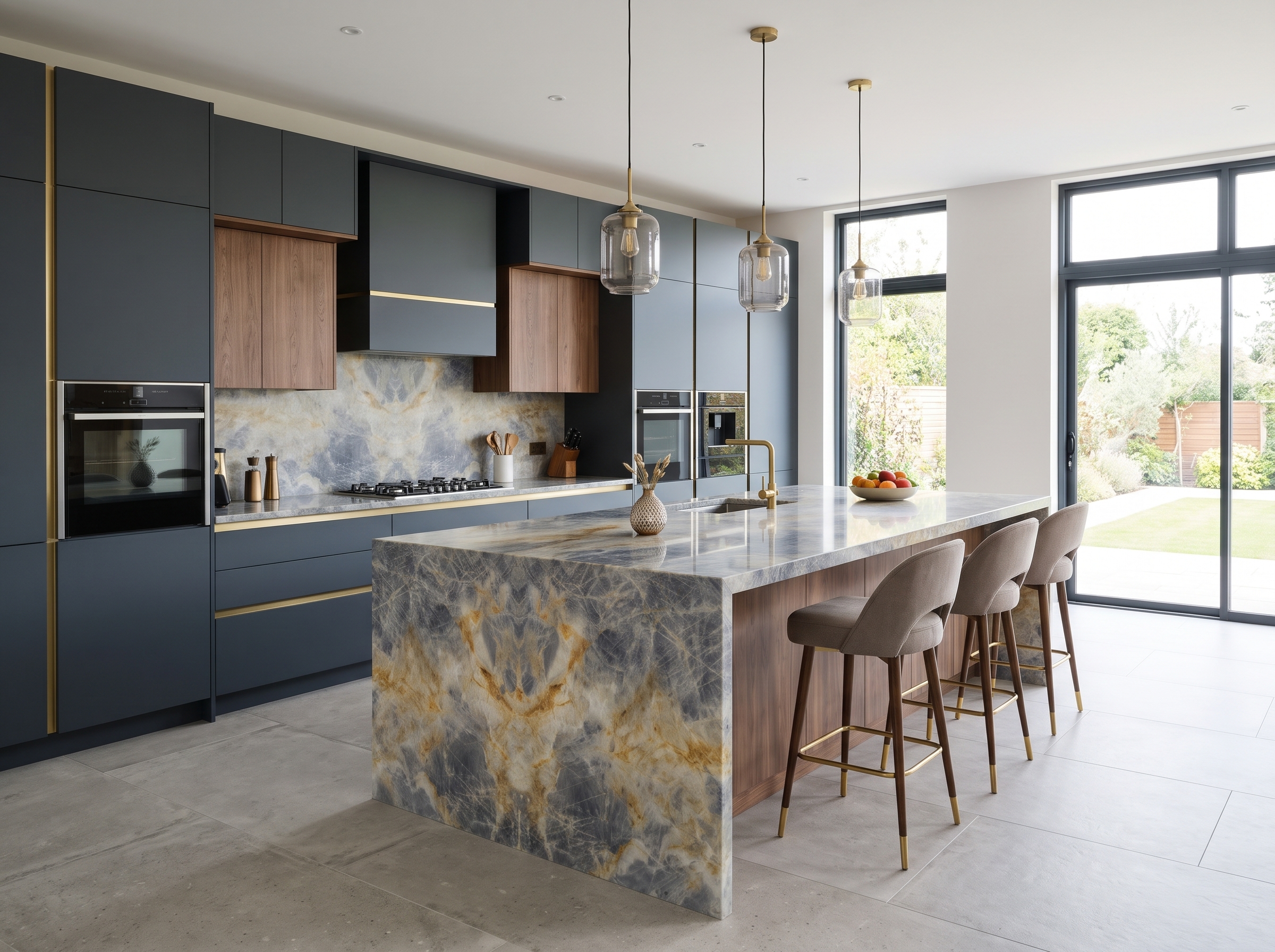
1. Waterfall Marble Kitchen Island
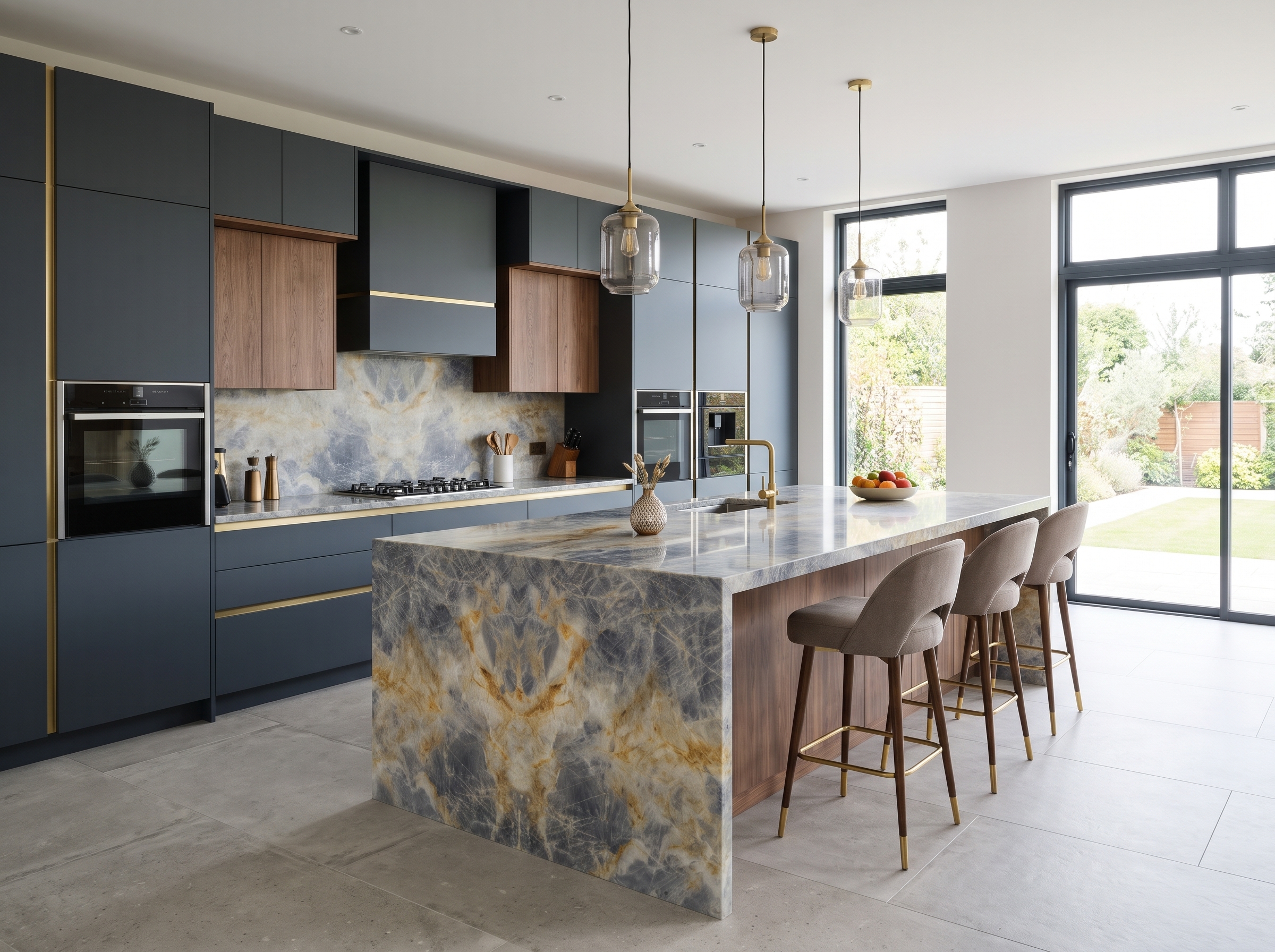
A waterfall kitchen island features a countertop that continues vertically down one or both sides of the island. This creates a continuous stone surface and allows the marble's veining to extend across horizontal and vertical areas.
This design can be particularly effective with marble featuring distinctive veining. Careful slab selection and cutting plans are important to achieve visual continuity between the surfaces.
2. Combining Marble and Wood
Combining the natural patterns of marble with the warm texture of wood can create balanced and timeless kitchen interiors.
Wooden cabinets, light-coloured marble countertops and natural colour palettes are suitable for projects aiming for a welcoming and comfortable atmosphere.
3. Creating Contrast with Different Colours
Using dark marble with light-coloured cabinetry or light marble with darker cabinets can create a strong visual contrast.
This approach helps distinguish the kitchen island from the surrounding surfaces and makes it a focal point within the room.
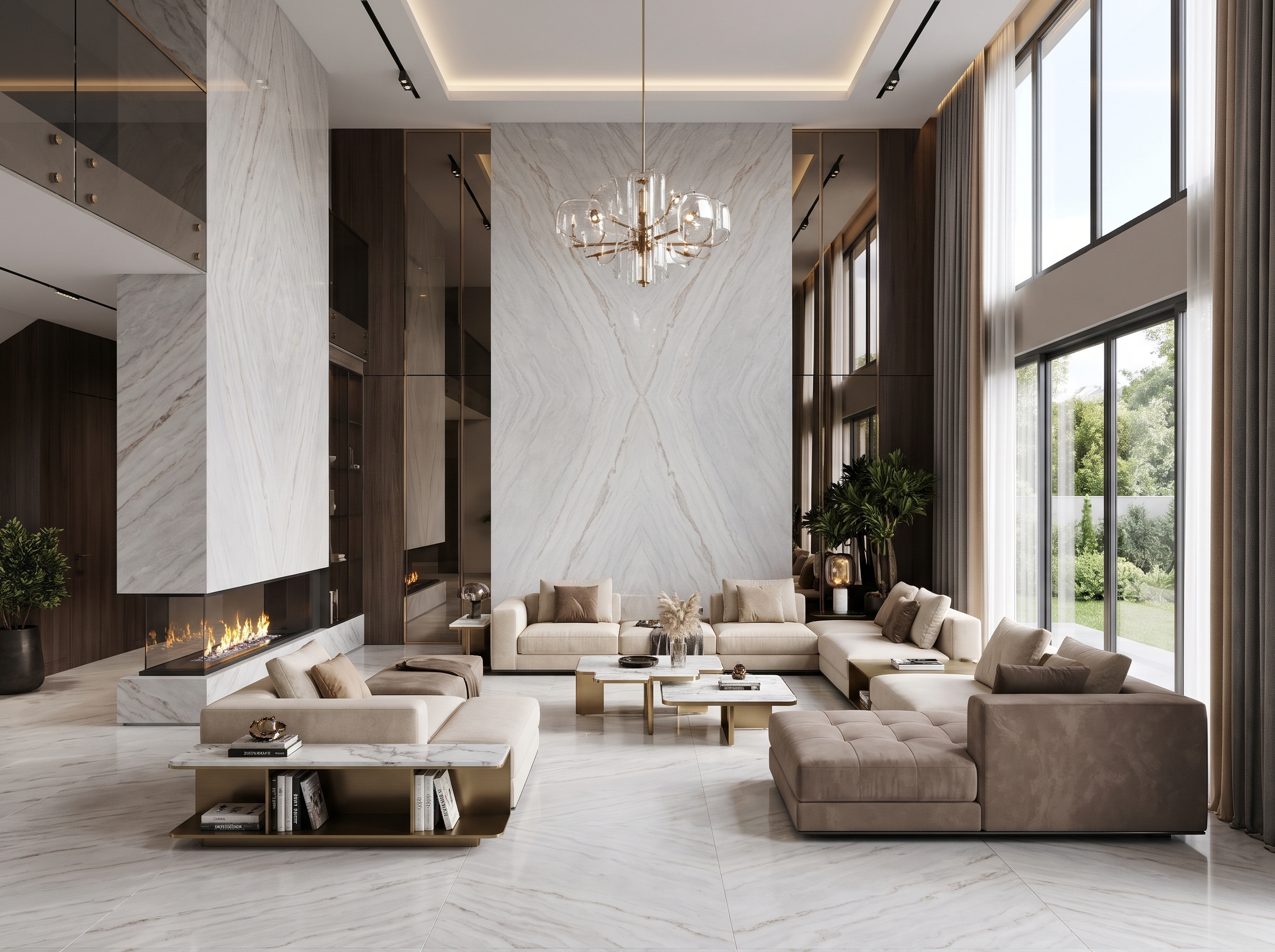
4. Vein Matching and Bookmatching
Bookmatching is a decorative technique in which two natural stone slabs are positioned next to each other so that their veining patterns mirror one another.
This technique can create a symmetrical and visually striking appearance, particularly with marble featuring pronounced veining. It can be used on large kitchen island side panels and custom-designed surfaces.
Suitable slab selection and careful planning before cutting are essential for successful bookmatching.
5. Thick-Looking Marble Countertop Edges
Thick-looking countertop edges can give a kitchen island a more substantial and distinctive appearance. This effect can be achieved through suitable cutting and joining techniques.
The edge design should complement the natural veining of the marble and the overall style of the kitchen cabinetry.
Advantages of Using Marble for Kitchen Islands
Marble offers several aesthetic and design advantages that make it a popular natural stone choice.
1. Unique natural patterns: Each marble slab has its own veining and colour distribution, creating surfaces that are visually distinctive.
2. Timeless aesthetics: Marble can complement different interior design styles, from traditional kitchens to contemporary spaces.
3. Design flexibility: Countertops, side panels and decorative details can be coordinated using the same natural stone.
4. Different surface finishes: Polished, honed and other finishes can be selected according to the desired appearance.
5. Natural character: Marble's mineral composition, veining and colour variations introduce a distinctive natural element into kitchen interiors.
What Should You Be Aware of When Using Marble for a Kitchen Island?
Although marble offers significant aesthetic appeal, its natural characteristics should be considered in areas exposed to frequent daily use.
Sensitivity to Acidic Substances
Marble may contain carbonate minerals such as calcite. Contact with acidic substances, including lemon juice, vinegar and certain foods, can cause surface dulling or etching.
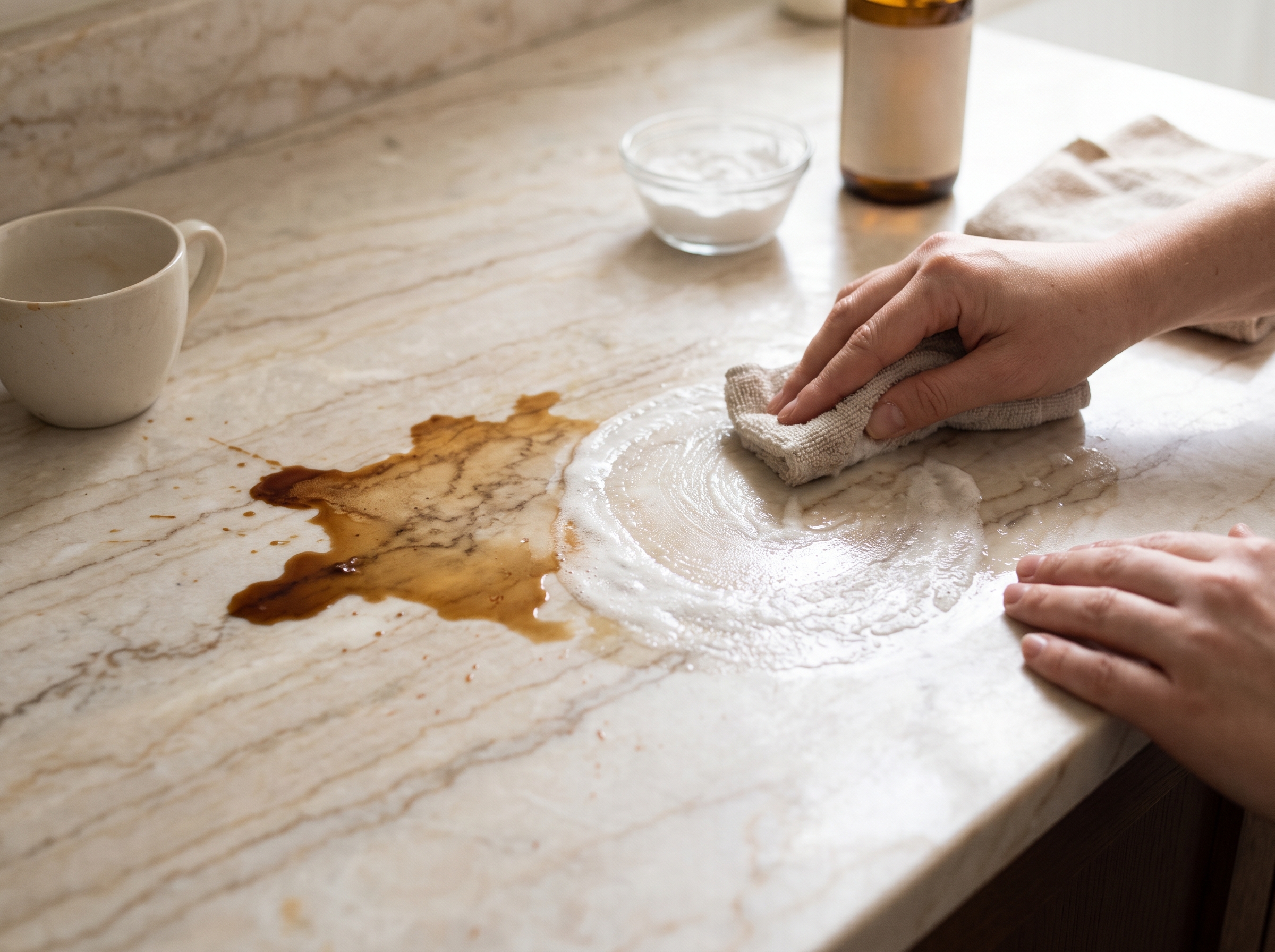
Acidic substances should not be left on marble surfaces for extended periods. Spills should be cleaned promptly using suitable cleaning methods.
Staining and Porosity
Marble's porosity and liquid absorption characteristics vary depending on the stone variety. Substances such as oil, coffee and wine may cause staining in certain types of marble.
Suitable impregnating sealers can be considered according to the characteristics of the stone. However, protective treatments do not make marble completely stain-proof.
Scratches and Impact Damage
Marble surfaces can be scratched or damaged by impacts during everyday use. Cutting boards should be used instead of cutting directly on the stone, and heavy objects should be handled carefully.
Regular Maintenance
Natural stone-compatible, pH-neutral cleaning products should be used for routine marble maintenance. Acidic cleaners, abrasive chemicals and harsh cleaning equipment should be avoided.
How to Clean and Protect a Marble Kitchen Island
Regular and appropriate maintenance helps preserve the appearance of a marble kitchen island.
-
Use a soft cloth and a pH-neutral cleaner suitable for natural stone.
-
Do not leave lemon juice, vinegar, wine or other acidic substances on the surface.
-
Clean coffee, oil and coloured liquid spills as soon as possible.
-
Use cutting boards and heat-resistant trivets.
-
Avoid abrasive sponges and acid-based cleaning products.
-
Consult a natural stone professional about suitable protective treatments.
The type of protective product and how frequently it should be reapplied depend on the marble's mineralogical composition, surface finish and intensity of use.
It is also important to understand that an impregnating sealer can reduce liquid absorption but does not prevent acid-related surface etching.
Marble or Granite for a Kitchen Island?
Marble and granite are frequently compared when choosing a natural stone for a kitchen island. Both materials have distinct aesthetic and physical characteristics.
|
Feature |
Marble |
Granite |
|---|---|---|
|
Appearance |
Distinctive veining and colour transitions |
Often features granular or crystalline patterns |
|
Natural pattern |
Flowing veins are prominent |
Mineral and crystal distribution is prominent |
|
Hardness |
Generally softer than granite |
Generally harder |
|
Acid sensitivity |
Sensitive to acidic substances |
Generally more resistant to household acids |
|
Maintenance |
Requires careful use and appropriate care |
Maintenance depends on the stone's characteristics |
|
Design appeal |
Elegant, natural and decorative |
Strong, durable and available in varied patterns |
The choice between these natural stones should not depend solely on appearance or hardness. Everyday usage habits and project requirements should also be considered.
How to Choose the Right Marble for a Kitchen Island
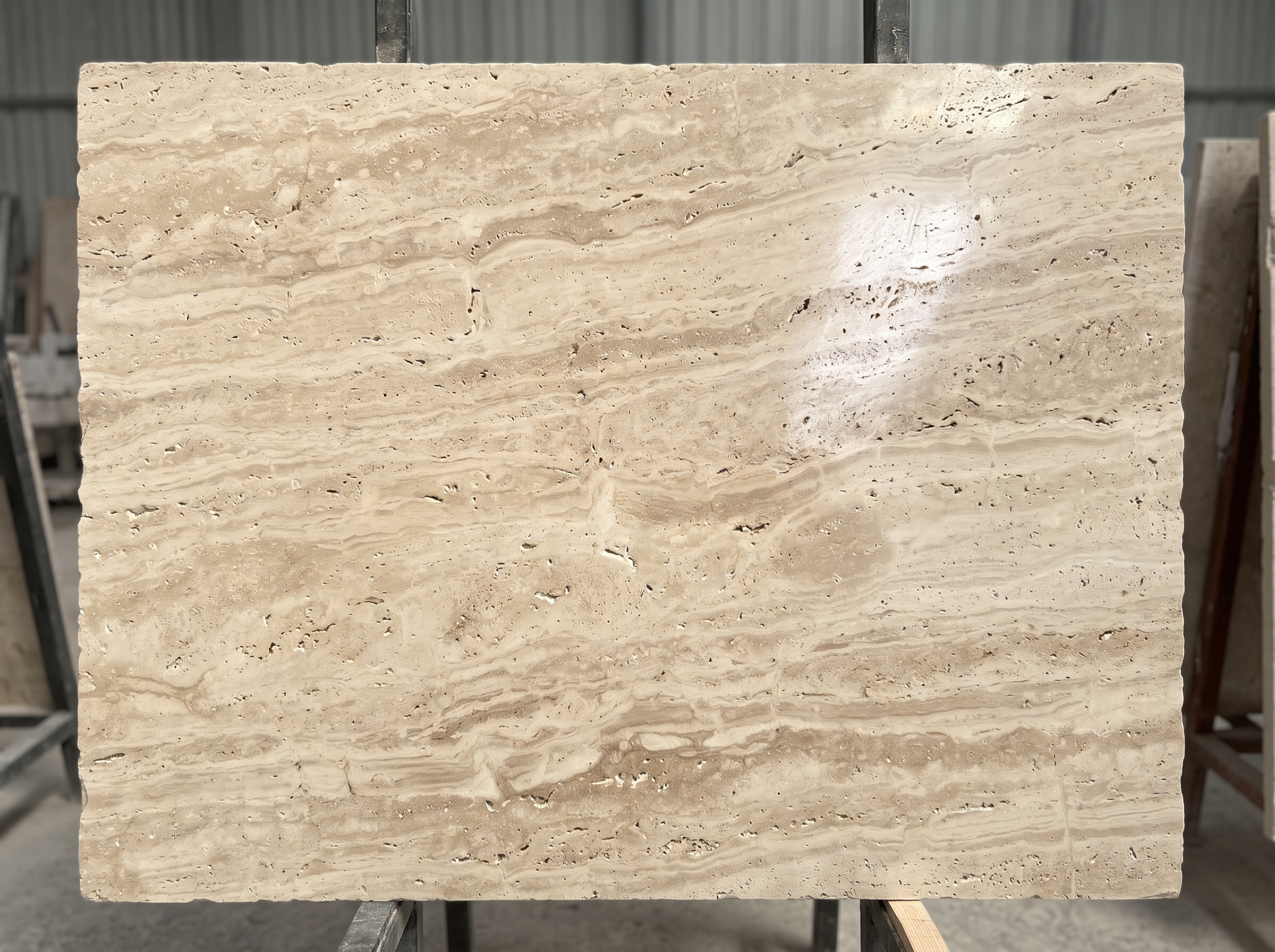
Before purchasing marble, it is advisable to inspect the actual slab whenever possible. Different slabs of the same marble variety may have variations in colour, veining intensity and pattern distribution.
The following factors should be evaluated during the selection process:
-
Choose a colour that complements the kitchen cabinetry and flooring.
-
Examine the direction and density of the veining in relation to the island dimensions.
-
Check for visible cracks, repairs, filled areas or other natural structural variations.
-
Review the stone's water absorption, porosity and maintenance characteristics.
-
Compare polished and honed finishes according to the intended use.
-
Determine the edge profile and slab thickness together with the fabrication details.
-
Prepare a cutting and vein-placement plan before fabrication whenever possible.
Inspecting the entire slab is particularly important for large kitchen islands, as it helps designers and buyers evaluate the final appearance before installation.
Frequently Asked Questions About Marble Kitchen Islands
Can marble be used for a kitchen island?
Yes. Marble can be used for kitchen islands thanks to its natural veining and variety of colours. However, its porosity, sensitivity to acidic substances and maintenance requirements should be considered when selecting the stone.
Do marble kitchen islands stain easily?
Depending on its porosity and surface characteristics, marble may develop stains from substances such as coffee, oil and wine. Suitable protective treatments can help reduce the risk of staining but cannot eliminate it completely.
Should I choose polished or honed marble for a kitchen island?
Polished marble offers a glossy and reflective appearance, while honed marble provides a matte and understated finish. The choice should depend on the kitchen design and the user's expectations regarding surface appearance and maintenance.
Can marble kitchen islands get scratched?
Yes. Marble can develop scratches and surface wear during frequent use. Using cutting boards and avoiding the movement of heavy or abrasive objects directly across the surface can help reduce damage.
Which marble colours are suitable for kitchen islands?
White, grey, dark and beige marble varieties can all be considered. The most suitable colour depends on the cabinetry, flooring, lighting and overall interior design.
What is a waterfall marble kitchen island?
A waterfall kitchen island is a design in which the marble countertop continues vertically down one or both sides of the island. This creates a continuous stone appearance and can highlight the natural veining of the marble.
Does marble need to be sealed on a kitchen island?
The need for sealing depends on the marble's porosity, mineralogical composition and surface finish. A suitable protective product should be selected with the advice of a natural stone professional. It is important to remember that sealing does not prevent acid-related etching.
Conclusion
Using marble on a kitchen island is an elegant design approach that brings the natural veining and distinctive character of stone into the centre of the kitchen. From white and light-coloured varieties to grey and darker shades, different marble options can complement both contemporary and traditional interiors.
However, selecting the right marble should involve more than aesthetic considerations. Physical properties, surface finish, slab thickness, edge details and maintenance requirements should all be evaluated together.
With appropriate material selection and fabrication, marble kitchen islands can create distinctive interiors that highlight the timeless character of natural stone.
Biser Marble offers natural stone selections with different colours, veining patterns and distinctive characteristics for architectural and interior design projects.