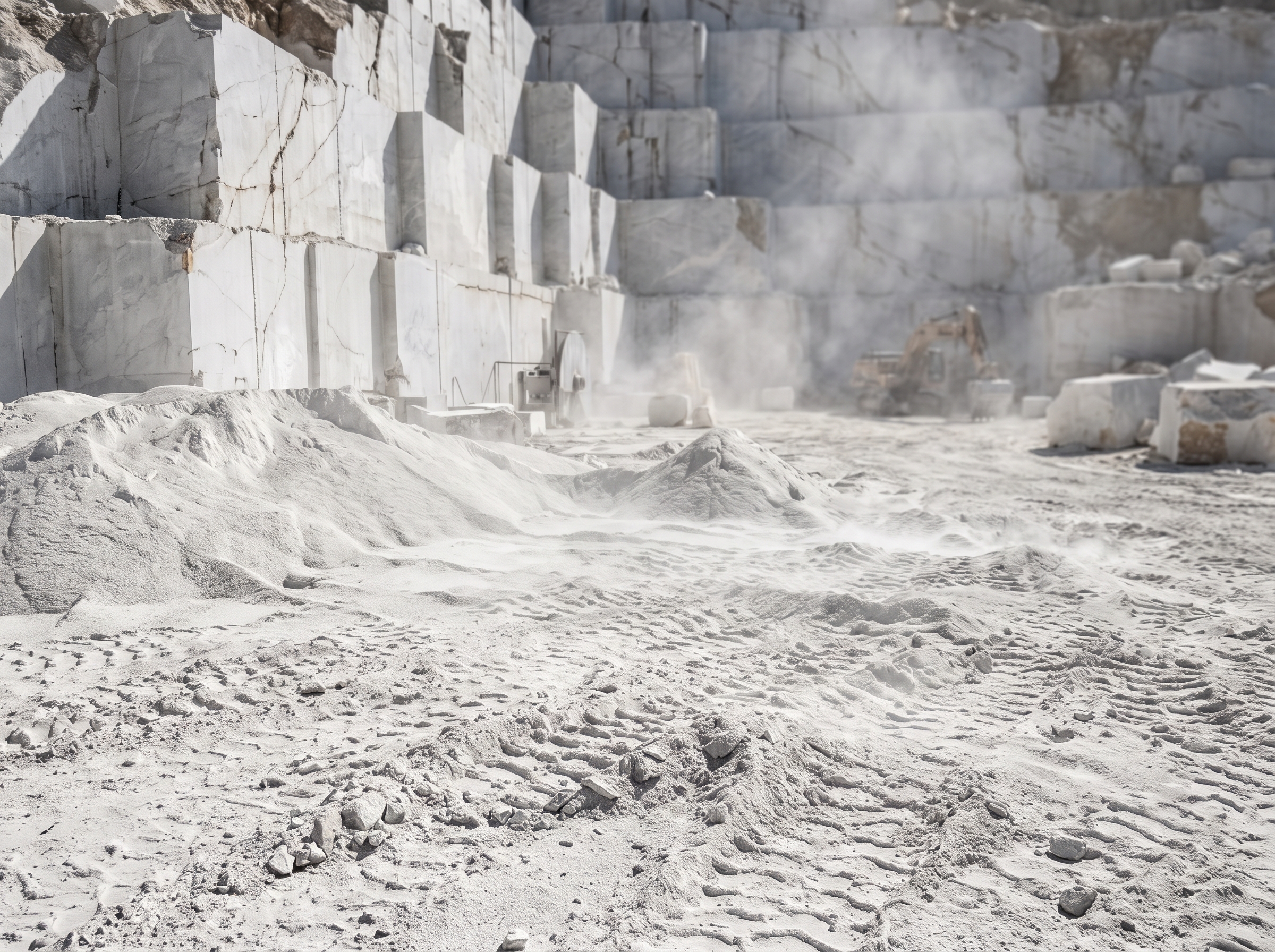
How Are Marble Dust and Marble Slurry Generated? Managing Stone Processing Waste
Marble undergoes several processing stages after being extracted from a quarry, including block cutting, slab production, sizing, surface treatment and polishing. These operations generate not only finished products but also different types of production residues, such as stone fragments, marble dust and marble slurry.
Marble dust and marble slurry are among the main fine-grained by-products of natural stone processing. Their proper collection, separation, dewatering and potential reuse are important aspects of responsible production, particularly because cutting and surface finishing can generate considerable quantities of fine mineral particles.
Waste management in the natural stone industry involves more than simply disposing of production residues. Reducing water consumption, recovering usable materials and finding suitable applications for secondary raw materials are also important elements of sustainable manufacturing.
This article explains how marble dust and marble slurry are generated, the differences between them, their potential environmental impacts and the methods used to manage and recover stone processing waste.
What Is Marble Dust?
Marble dust consists of fine stone particles generated during the cutting, shaping, grinding and finishing of marble.
Marble is generally composed of carbonate minerals, primarily calcite and, in some varieties, dolomite. During processing, small particles of these minerals are separated from the stone and become dust.
Marble dust can be generated during:
-
Cutting marble blocks with diamond wire or saws
-
Processing blocks into slabs
-
Sizing slabs according to project requirements
-
Edge cutting and shaping
-
Surface grinding and calibration
-
Honing and polishing
-
Mechanical treatment of marble surfaces
The particle size of marble dust varies according to the machinery, cutting method and finishing process. Some operations generate relatively coarse stone particles, while others produce much finer mineral dust.
What Is Marble Slurry?
Marble slurry is a mixture of fine stone particles and water generated during marble cutting and processing.
Water is commonly used during cutting to help control heat, cool processing equipment, clean the cutting area and carry away stone particles. As the water comes into contact with the material removed from the marble surface, it forms a slurry.
Depending on the production process, marble slurry may contain:
-
Fine marble and mineral particles
-
Process water
-
Sediment from cutting and grinding
-
Abrasive or auxiliary material residues, depending on the equipment
-
Residues from resins and surface treatment chemicals in certain operations
The physical consistency of marble slurry depends on its solid content and water ratio. Fresh slurry may be relatively fluid, while material collected after settling or dewatering can become dense and semi-solid.
What Is the Difference Between Marble Dust and Marble Slurry?
Although marble dust and marble slurry can originate from the same processing operations, they differ in physical form and management requirements.
| Feature | Marble Dust | Marble Slurry |
|---|---|---|
| Physical form | Dry or damp fine stone particles | Mixture of water and fine stone particles |
| Generation | Cutting, grinding, sizing and surface finishing | Mainly water-assisted cutting and processing |
| Water content | May be low | Generally high |
| Collection method | Dust extraction and filtration systems | Drainage channels, tanks and settling systems |
| Treatment requirements | Separation, screening and quality assessment | Settling, dewatering and filtration |
| Potential recovery | Depends on particle size and purity | Requires dewatering and material analysis |
In simple terms, marble dust refers to the fine stone particles themselves, while marble slurry is the mixture of these particles and process water. When slurry is dewatered, the remaining solid material may be recovered as fine marble residue.
At Which Stages of Marble Production Is Waste Generated?
Marble production involves several stages, from quarry extraction to the manufacture of finished products. Different types of production waste can arise at each stage.
1. Marble Block Extraction
The production process begins with the extraction of marble blocks from natural stone quarries. Cutting, separating and shaping the blocks can generate stone fragments and fine mineral residues.
When water-assisted methods such as diamond wire cutting are used, fine stone particles can mix with water and form slurry. Depending on the equipment and extraction method, dry or damp fine residues may also be generated.
2. Block Cutting and Slab Production
Extracted marble blocks are transported to processing facilities, where they are cut into slabs. Gang saws, multi-wire machines and other cutting systems may be used depending on the production requirements.
Friction and abrasion during cutting separate fine mineral particles from the stone. Water used in the process carries these particles away, resulting in slurry.
3. Sizing and Edge Processing
Marble slabs are cut to the dimensions required by a project or customer. Edge cutting and shaping operations can generate small stone fragments, offcuts and fine marble dust.
When water is used during these operations, the fine particles are collected together with the process water.
4. Surface Grinding and Polishing
Grinding, honing and polishing are used to achieve the desired surface quality and appearance of marble slabs.
These processes remove very fine mineral particles from the stone surface. When water-assisted machinery is used, the particles mix with the water and form fine-grained slurry.
Abrasives, resins and other auxiliary materials used during finishing may also influence the composition of the resulting waste.
How Is Marble Slurry Generated?
Understanding the role of water in cutting and surface treatment is essential to understanding how marble slurry is formed.
During marble processing, water is supplied to the cutting area in a controlled manner. Its main functions include:
-
Helping reduce heat generated during cutting
-
Cooling cutting equipment
-
Carrying stone particles away from the processing area
-
Helping control airborne dust
-
Cleaning the working area
As the cutting equipment removes material from the marble, fine particles mix with the water. The resulting mixture is directed through drainage channels into settling tanks or wastewater collection systems.
The solid particles gradually settle at the bottom of the tanks. The clearer water remaining at the top can be treated, checked and returned to the production process where suitable.
This cycle is one of the main methods used to reuse water in marble processing facilities.
Environmental Impacts of Marble Processing Waste
If marble dust and slurry are not managed properly, they can create environmental and workplace challenges.
1. Soil Contamination and Physical Changes
Uncontrolled disposal of marble slurry can affect the physical structure of soil. Fine mineral particles may accumulate on the ground and influence soil porosity and water movement.
If the waste contains additional substances from processing operations, the potential environmental risks may increase.
2. Water Pollution
If marble slurry enters streams, drainage channels or other water bodies without appropriate treatment, it can increase suspended solids and turbidity.
This may contribute to sediment accumulation and negatively affect aquatic habitats.
3. Air Quality and Dust Generation
Uncontrolled release of dry marble dust can increase airborne particulate matter around processing facilities and nearby areas.
Inhalation of fine mineral particles is an important occupational health consideration. Although marble is generally composed of carbonate minerals, its mineralogical composition may vary, and some stone materials can contain crystalline silica. Dust should therefore not be assumed to be harmless without appropriate assessment.
Suitable ventilation, enclosed dust extraction systems, wet processing methods and appropriate personal protective equipment should be used in production environments.
4. Increasing Waste Storage Requirements
Stone processing can generate significant quantities of slurry and other residues. Storing these materials without recovery can require additional land and create ongoing management costs.
Separating waste at the source and identifying suitable recovery options can help reduce these challenges.
How Is Marble Slurry Treated and Dewatered?
The main objectives of marble slurry management are to separate fine mineral particles from water and reuse the recovered water whenever possible.
Processing facilities may use different systems depending on their production capacity and technical requirements.
1. Settling Tanks
Settling tanks are among the basic systems used to manage marble slurry.
The mixture of water and fine stone particles is directed into tanks. Over time, the solid particles settle at the bottom under the influence of gravity.
The clearer water collected at the top can be returned to production when its quality is suitable. The accumulated sediment is removed at regular intervals.
2. Flocculation and Coagulation
Some facilities use chemicals known as coagulants or flocculants to help fine particles form larger aggregates and settle more efficiently.
These substances can improve the settling process by bringing suspended particles together.
The type and quantity of chemicals should be selected according to the characteristics of the slurry and the intended use of the recovered water.
3. Filter Press Systems
A filter press is a mechanical system used to dewater marble slurry.
The slurry is pumped under pressure through filter cloths. Water passes through the filtration surfaces, while solid particles accumulate inside the filter chambers and form a denser filter cake.
This process can:
-
Reduce the volume of slurry
-
Separate solid and liquid phases
-
Increase the amount of water available for recovery
-
Make solid residues easier to transport and store
Whether the resulting filter cake can be reused depends on its composition and technical properties.
4. Mechanical Dewatering and Filtration
Depending on plant capacity and slurry characteristics, other mechanical dewatering and filtration systems may also be used.
The objective is not only to separate water from solids but also to assess whether the recovered water is suitable for reuse in the production process.
How Can Marble Dust and Slurry Be Recycled?
Not all marble processing residues have the same characteristics. The appropriate recovery method depends on factors such as chemical composition, mineral structure, particle size, moisture content and possible contamination.
Marble dust and slurry with suitable properties can be evaluated as secondary raw materials in different industries.
1. Cement and Concrete Production
One potential application for marble processing residues is the cement and concrete industry.
Fine marble particles with suitable physical and chemical characteristics may be used as mineral fillers or fine aggregate components in specific formulations.
However, marble dust should not be assumed to be a direct replacement for cement in unlimited quantities. Its application rate must be determined through laboratory testing, considering particle size, mineral composition and the required performance of the concrete.
2. Ceramics and Construction Materials
Marble dust may be used in ceramic production and certain construction materials when its composition and particle size meet the relevant requirements.
Its mineral content can serve as a filler or raw material component in selected production formulations. Chemical purity and behaviour at processing temperatures are important considerations for ceramic applications.
3. Lime and Mineral Filler Applications
Marble dust with a high calcium carbonate content and suitable purity may be considered for certain industrial mineral filler applications.
Important characteristics include particle size distribution, brightness, chemical purity and moisture content.
4. Road and Infrastructure Materials
Marble residues that meet relevant technical specifications may be evaluated as aggregate or filler materials in certain road and infrastructure applications.
Before use, properties such as strength, particle size distribution, water absorption and compliance with applicable technical standards should be assessed.
5. Other Industrial Applications
Research has also examined the potential use of marble slurry in various construction products, plaster, binding systems and selected environmental applications.
However, each application requires an assessment of the waste material and the performance of the final product. A recovery method that works for one processing plant cannot automatically be applied to every type of marble residue.
The Importance of Water Recycling in Marble Processing
Water is an important production input, particularly during marble cutting and surface treatment. Reusing process water is therefore essential for improving resource efficiency and managing wastewater.
In closed-loop water systems, water used during processing is collected, treated through settling or filtration and returned to the production process.
The main benefits include:
-
Reducing freshwater consumption
-
Controlling wastewater discharge
-
Lowering operating costs associated with water use
-
Improving resource efficiency
-
Supporting more controlled slurry management
For these systems to operate effectively, settling tanks should be cleaned regularly, filters should be inspected and recovered water quality should be monitored to ensure it meets equipment requirements.
Key Considerations for Marble Processing Waste Management
A sustainable marble production process requires waste management planning at every stage.
| Management stage | Possible method | Main objective |
|---|---|---|
| Waste collection at source | Separate collection channels and systems | Prevent different waste streams from mixing |
| Dust control | Wet cutting and suitable extraction systems | Reduce airborne particles |
| Slurry separation | Settling and filtration | Separate solid and liquid phases |
| Dewatering | Filter presses and mechanical systems | Reduce slurry volume |
| Water recovery | Closed-loop water systems | Reduce freshwater consumption |
| Solid waste recovery | Reuse in suitable industries | Obtain secondary raw materials |
| Final disposal | Authorized facilities in accordance with regulations | Manage non-recoverable waste safely |
The classification, temporary storage, transportation and disposal of waste should comply with applicable environmental regulations. Slurry that may contain chemical residues should not be classified as inert or harmless based solely on its appearance.
Sustainability and the Circular Economy in Marble Production
The circular economy approach aims to reduce the consumption of natural resources and recover materials generated during production.
In the marble industry, this approach covers the entire production chain, from block extraction to finished products. Examples include converting small stone offcuts into different products, using suitable fine mineral residues in other industrial applications and recovering process water.
Three key principles support this approach:
-
Reduce waste generation: Improve cutting plans and production efficiency to prevent unnecessary material losses.
-
Separate waste correctly: Collect residues from different production stages without mixing incompatible materials.
-
Develop recovery opportunities: Identify suitable applications according to the physical and chemical properties of the material.
Recovering marble processing waste can contribute to more efficient use of natural resources. However, the environmental and economic benefits of recycling should also be evaluated in terms of transportation, dewatering, energy consumption and final product quality.
Frequently Asked Questions About Marble Dust and Marble Slurry
How is marble dust generated?
Marble dust is generated when fine mineral particles are removed from the stone during block cutting, slab production, sizing, grinding, honing and polishing.
Why is marble slurry produced?
During marble cutting and processing, water carries away fine particles removed from the stone surface. The resulting mixture of water and mineral particles is known as marble slurry.
Can marble slurry be recycled?
Yes. Marble slurry with suitable characteristics can be dewatered, tested and evaluated for use in concrete, cement, ceramics and certain other construction materials.
How is marble slurry dried?
Marble slurry can first be separated in settling tanks. Its water content can then be reduced using a filter press or other mechanical dewatering equipment.
Is marble dust harmful?
Inhalation of marble dust can present respiratory health risks, particularly with prolonged exposure to fine airborne particles. The mineral composition of the stone is also important. Dust extraction, appropriate ventilation and occupational health measures should be implemented.
Can water used in marble processing be reused?
Yes. Settling, filtration and suitable water treatment systems can allow process water to be recovered and reused. Water quality should be monitored to ensure that it meets production requirements.
Which industries can use marble processing waste?
Depending on its characteristics, marble processing waste may be evaluated for use in cement, concrete, ceramics, construction materials, mineral fillers and selected road infrastructure applications.
Conclusion: Why Is Waste Management Important in Marble Production?
Marble dust and marble slurry are important by-products of cutting and processing natural stone. Their proper collection, separation, dewatering and recovery can help reduce environmental impacts and improve resource efficiency.
In particular, reusing process water through closed-loop systems and evaluating suitable mineral residues as secondary raw materials can support more sustainable practices in the natural stone industry.
Sustainable marble production is not only about manufacturing high-quality products. It also involves using resources efficiently and managing production residues responsibly at every stage.